
Client Background
Hotel Pauwa, a developing chain of hotels in Nepal known for its comfort, authentic cuisine, and warm hospitality, faced various problems before adopting Tuna HMS(Hotel Management System). They were not able to effectively manage multiple branches because the data was so fragmented, operations were manual and the quality of service was not unified that management had a hard time in controlling operations and ensuring high guest satisfaction.
The common problems were the errors in the reservation, mismatch with billing, and ineffective room service process, which slowed decision-making and growth of the Hotel Pauwa.
Hotel Pauwa had 6 branches at the time of software implementation. Through Tuna HMS, the hotel chain converted their business into a centralized, automated and real time management system and they were able to venture into 16 branches in Nepal.
The management is targeting 50 branches in 5 years and 100 branches in 10 years, with a plant to expand internationally. To achieve this vision, the hotel needed a strong, scalable and fully integrated management system. The software has not only made the day-to-day operations easier but also enhanced loyalty of the guests, efficiency of the staff, and the overall performance of the business.
Challenges Before Tuna HMS
Prior to the implementation of Tuna HMS, Hotel Pauwa was experiencing serious operational, financial and guest service problem in its branches:
Fragmented Data and Decentralization
- Branches were almost autonomous; Almost 100% data was at the branch level and not centralized.
- The managers took 5-7 hours a week to consolidate weekly reports by making phone calls and sending e-mails to branches.
- Because of the decentralized branch data, consolidating the financials took multiple accountant staffs to record the accounting data in a systematic way.
- The KPI monitoring between branches was slow and the average decision time took up to 1 week.
Check-in and Reservation Inefficiencies
- Bookings and paper-based reservations were done manually which resulted in a 15-20% error in room allocation.
- There were 7-10 incidents of overbooking and double-booking every week.
- Customers/Travelers were unable to make bookings through a Website or a mobile app, which caused direct booking loss of 30-35%
Inefficiency in operations and billing mistakes
- Orders were entered manually in paper records by waiters; between 10-12% of the orders were lost or delayed.
- The mismatches in billing were 5-8 %, which resulted in complaints by the guests.
- Employees were wasting 20-25% of their working hours correcting mistakes instead of serving guests and improving satisfaction.
Poor digitization of booking and payment.
- No booking mobile booking application and website; online booking revenue was negligible.
- Manual payments that were in the form of cash created a delay of 1-2 days for reconciliation.
- There was no RTGS(real-time gross settlement) by using eSewa, Fonepay, or Khalti.
Absence of Mobile and Real-Time Visibility
- Managers were unable to get real-time business performance, occupancy and inventory data remotely.
- An insight of operations arrived 1 week late to management through calls or branch reports.
- The most important decisions, such as staffing adjustments, peak pricing, or stock restocking, were reactive and not proactive.
Food & Beverage Issues: Recipe vs BOM Confusion
- The kitchen applied various recipes in branches, which led to inconsistency in taste.
- None of the appropriate bill of materials (BOM) was used.
- It was also 12-18% more expensive due to the lack of standard recipes in food.
- There is no centralized control over the raw materials consumption, which resulted in wastages and stock mismatches.
Gaps in Equity and Financial Management
- There was an inconsistency in revenue sharing, investor dividend, investor payouts, departmental commissions, and tracking branch profits.
- There were 8-12% revenue leakages caused by financial errors.
- Internal issues were experienced as equity adjustments in different branches took 1-3 days.
Inefficiencies in HR and Workforce Management
- Scheduling of staff was done manually and resulted in 15-20% shift clashing as well as manpower imbalance during peak hours.
- Tracking the attendance and overtime was done manually on paper, causing 8-12% mistakes in calculating the payroll and staff complaints.
- The level of productivity was low; the staff were wasting 20-25% of their time making corrections on the roster and solving attendance issues rather than serving to guests.
Seasonality and forecasting Problems
- Historical records were poor in forecasting since occupancy was unpredictable, through manual forecasting.
- The management of staff and inventory was not efficient during the peak/off-peak seasons.
- Lost 5-10% revenues in seasonal peaks due to manual errors.
Guest Experience and Loyalty Problems
- No CRM to monitor the preference of the guests, their previous experience, or loyalty.
- Repeat guest rate was 20-25% lower than the industry average.
- There was also a lack of collection of guest feedback, which resulted in complaints not being addressed and even lowered brand goodwill.
Document and Incident Management Problem
- Customer complaints, lost goods, or damage incidents were managed via calls or paper notes, which made it time-consuming and very difficult to track the records.
- It was not possible to attach the supporting documents like citizenship, passport etc to overcome the incidents.
- It took an average of 2-3 days to resolve the incident, which was annoying to both the guests and the staff.
Communication Issues
- Managers took 10-15% of their time coordinating between branches through calls or messages.
- Loss of opportunities in upselling, bookings, and promotions were created by decision-making delays.
Tuna HMS Implemented Results
After the implementation of Tuna HMS(Hotel Management System), Hotel Pauwa changed into a centralized, data-driven, and automated hospitality group. The software allowed making decisions faster, increased guest satisfaction, controlled financial leakage due to an integrated accounting system, enhanced business operations, standardized food quality, and supported the growth of the business quickly.
The following are the main areas of improvement realized:
Complete Centralization and Live Control
- All the data on the branch (rooms, reservations, revenue, inventory) were centralized in a single Hotel Management System.
- The time of weekly reporting decreased from 5-7 hours to 10-15 minutes.
- The time required to make decisions was reduced from 1 week to real-time.
- The Head Office is now able to track KPIs of each branch in real-time.
- Autonomy at branches is substituted with standardized and controlled operations.
Easy Online Booking System and Mobile Application
- Hotel Pauwa mobile application and Web-based reservation system helped the guests to make their room reservations at any time.
- The revenue of direct booking increased by 25-30%.
- Overbooking decreased to 7-10 cases/week to 0.
- The accuracy of room allocation increased to 99%+ as compared to 80-85%.
- Check-in time has been shortened by 50% with proper management of digital id upload.
Operational Efficiency & Zero Billing Mismatches
- The order entries were fully digitalized; the loss of orders has been reduced from 10-12% to 0-1%
- Mismatches of billing also decreased from 5-8% to less than 1%.
- Employees/Staff saved to 20-25% of their daily hours, which enabled them to focus on guest service improvement.
- Billing synchronization helped to remove confusion, delays and wrong bills.
Uniform Recipes and Accurate BOM
- There is a standardization of all branches in terms of recipes.
- Automation of BOM (Bill of Materials) lowered the food cost variance from 12-18% to 3-5%.
- There was an increase in the accuracy of raw material consumption by 25-30%.
- The taste of food became standard in all branches, which enhanced satisfaction among the guests.
- The wastage was minimized by 10-15 through the central control of the kitchen.
Inventory Automation and Reduction of Waste
- Real-time stock updates and notifications helped to eliminate excess ordering and shortage.
- Monthly wastage reduced by 15–20%.
- Transparency and stock prices were enhanced through branch-to-branch stock comparison.
- The stock analysis between branches enhanced pricing comparison and transparency.
- The purchase forecasting was enhanced by the data-driven recommendations.
Online Payments and Rapid Cash Flow
- Incorporation with eSewa, Fonepay, Khalti made it possible to be able to make instant online and QR payments.
- Time taken to reconcile payments was cut by 1-2 days to real-time.
- Refunds and advance payments are done digitally with no disagreement.
- The cash handling was cut significantly, enhancing financial transparency.
Tuna Waiter App – Create a faster service and improved coordination.
- Waiters are ordering on a mobile application instantly.
- There was a reduction of order delivery time by 25-40%.
- Table turnover improved by 15–20%.
- Handwriting or oral communication mistakes were totally removed.
- Automated KOT/BOT enhanced the productivity of the staff.
QR Ordering – Rapid, Paperless, and Error-Free
- Guests can use a QR code to place an order in the dining table or room.
- Eliminated the waiting time for staff from guests/customers
- Increased average order value by 12-18% due to upsell recommendations.
- Reduces the workload of staff during the busy period.
Tuna Aaina -Ultimate Business Intelligence Dashboard
Tuna Aaina provides its owners and management with a 360-degree visual dashboard of the whole chain of hotels:
- Online occupancy, income, and branch ranking.
- Daily sales comparison
- Inventory consumption analysis.
- Profitability reports
With Tuna Aaina(Owner App), the management now utilizes data to make decisions, rather than assumptions, phone calls.
CRM, Guest Profiles & Loyalty System
- All guest profiles are created online with the history, preferences and documents attached.
- The rate of loyalty and repeat business increased by 25-30%.
- Complaints rate was minimized by automated feedback forms.
- Service recovery was made quicker and more personal.
Streamlined HR and Workforce Optimization
- Shift scheduling was also done automatically, this made rosters conflict-free and the staff at the right place at the right time in all the branches.
- Real-time attendance, leave and overtime monitoring ensured there were no disputes regarding payroll and 100% accuracy.
- The productivity of the staff improved greatly as employees could focus on service optimization; the efficiency grew by 30-40%
Digitized Document and Incident Management
The employees are able to add documents (ID, photographs, receipts etc.) directly in the system.
- Time to resolve incidents decreased to 2-3 days to one day
- No information lost, no records lost.
- The management is able to review, track and close the incidents online.
Automated Accounting & Finance Management
- The sharing of revenues, the payouts to investors and the sharing of profits are automated.
- Leakages in finances lowered from 8-12% to less than 2% through a perfect and compliance-ready accounting & finance management module.
- Monthly settlements that previously required days are now done within minutes.
Forecasting & Intelligent Decision Making
- Forecasting based on AI-enhanced occupancy planning.
- Lost revenue in high seasons decreased by 5-10% to almost 0%.
- The staff scheduling is now done on the basis of forecasted occupancy.
- The process of procurement planning became precise and cost-efficient.
Tangible Results After Implementing Tuna HMS at Hotel Pauwa
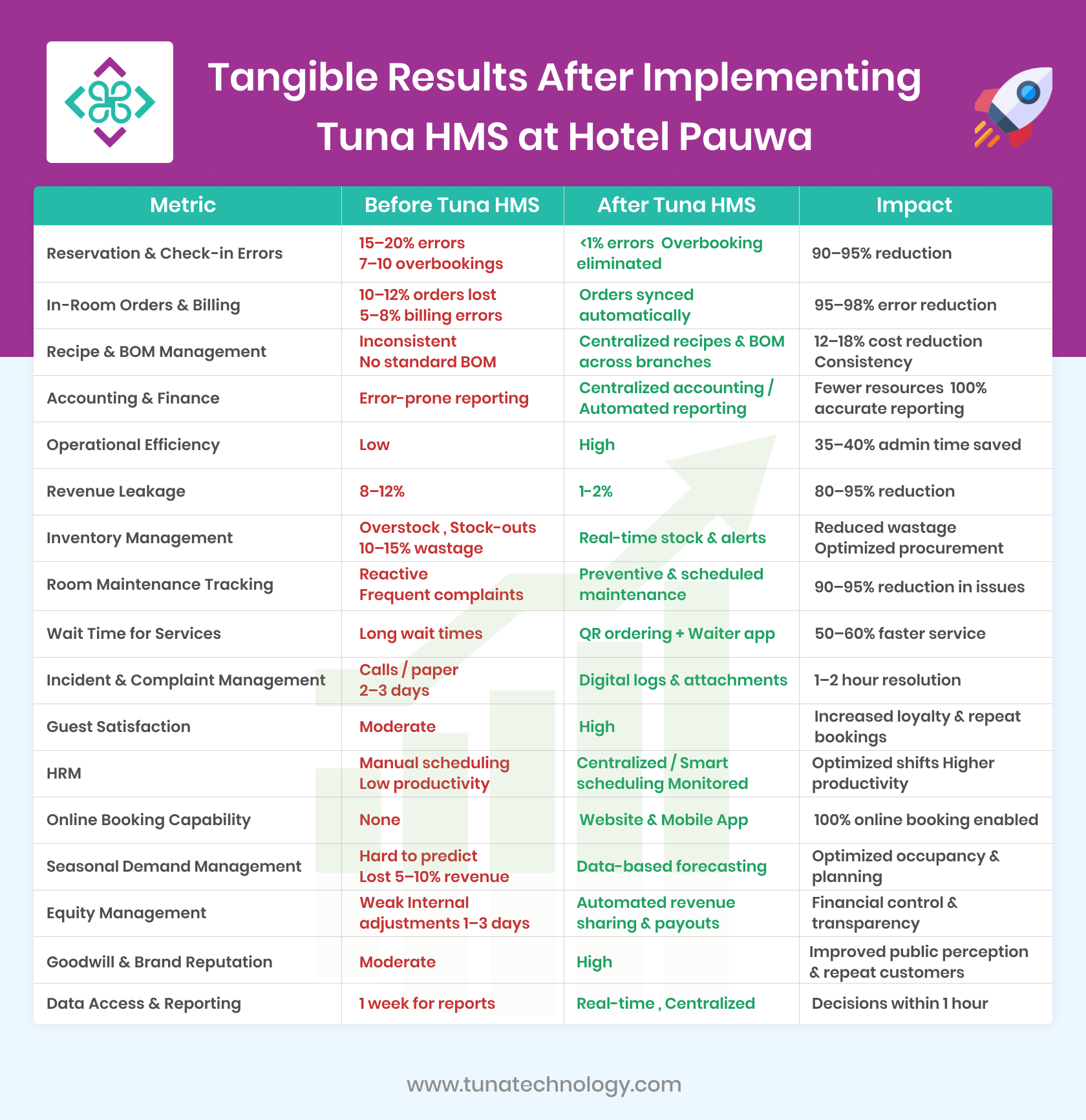
- Reservation & Check-in Errors
Before: 15–20% errors, 7–10 overbookings
After: <1% errors, overbooking eliminated
Impact: 90–95% reduction - In-Room Orders & Billing
Before: 10–12% orders lost, 5–8% billing errors
After: Orders synced via Waiter App, accurate billing
Impact: 95–98% error reduction - Recipe & BOM Management
Before: Inconsistent, no standard BOM
After: Centralized recipes & BOM
Impact: 12–18% cost reduction, quality consistency - Accounting & Finance
Before: Multiple accountants, error on reporting, 5–7 hours weekly to consolidate
After: Centralized accounting, automated reporting, consolidation in 10–15 mins
Impact: Fewer human resources, 100% accurate reporting - Operational Efficiency
Before: Low
After: High
Impact: 35–40% admin time saved - Revenue Leakage
Before: 8–12%
After: 1–2%
Impact: 80–95% reduction - Inventory Management
Before: Overstock, stock-outs, 10–15% wastage
After: Real-time stock & alerts
Impact: Reduced wastage, optimized procurement management - Room Maintenance Tracking
Before: Reactive, frequent complaints
After: Preventive & scheduled maintenance
Impact: 90–95% reduction in issues - Wait Time for Services
Before: Long wait times
After: QR ordering + Waiter App
Impact: 50–60% faster service - Complaint & Incident Management
Before: Calls / paper, 2–3 days
After: Digital logs & attachments
Impact: 1–2 hour resolution - Guest Satisfaction
Before: Moderate
After: High
Impact: Increased repeat bookings & loyalty - HRM
Before: Low productivity
After: High productivity
Impact: Optimized the HR issues - Online Booking System
Before: None
After: Website & mobile app
Impact: 100% online booking enabled - Seasonal Demand Management
Before: Hard to predict, lost 5–10% revenue
After: Data-based forecasting
Impact: Optimized occupancy & planning - Equity Management
Before: Weak, internal adjustments 1–3 days
After: Automated
Impact: Increased transparency - Goodwill & Brand Reputation
Before: Moderate
After: High
Impact: Improved public perception & repeat customers - Data Access & Reporting
Before: 1 week for reports
After: Real-time, centralized
Impact: Decisions within 1 hour
Conclusion
With Tuna HMS (Hotel Management System), Hotel Pauwa became a centralized, automated, and data-driven hospitality group. Real-time visibility, standardized operations, and digitisation of the guest services enable the hotel to run smoothly, improve the satisfaction of the guests, and contribute to the rapid growth. The success story of this hotel management software demonstrates how a hotel management system can turn a multi-branch hotel into an efficient, profitable, and well-managed operation and enable the management to concentrate on strategic growth and development rather than on daily operational issues.
Are you prepared to run your hotel like Hotel Pauwa?
Get a taste of the benefits of hotel management system software – Book a free consultation and demo of Tuna HMS.